


Ever felt like the world could use a little more understanding and compassion? In a time when divisions seem to run deep, diving into Charlie Kirk quotes on empathy might just be the spark you need to bridge those gaps.
Charlie Kirk Quotes on Empathy

Charlie Kirk said he can’t stand the word empathy, actually. He thinks it is a made-up, New Age term that does a lot of damage, though it is effective in politics. He prefers sympathy over empathy.
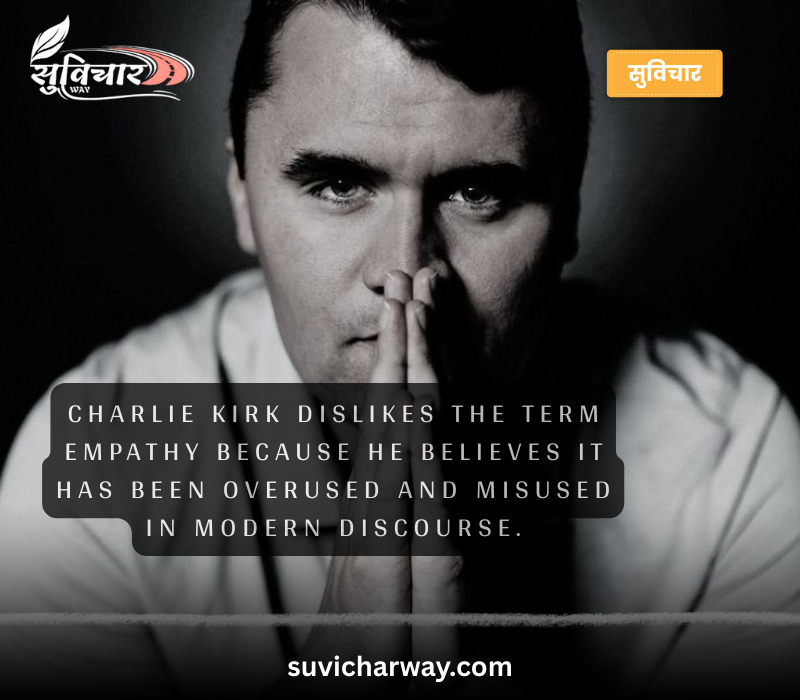
Charlie Kirk dislikes the term empathy because he believes it has been overused and misused in modern discourse.
He argued that empathy as a concept is often counterproductive and frequently weaponized in political arenas.
Kirk expressed that empathy tends to be a buzzword rather than a meaningful foundation for action.
According to him, empathy’s popular usage has damaged serious debate by shifting focus to emotion over facts.
He prefers sympathy over empathy, because sympathy allows understanding without claiming to feel another’s pain.
In his view, feeling exactly what someone else feels — the core of empathy — is impossible.
Kirk has said that empathy is a trendy term that distracts from genuine concern or help.
He described empathy as a creation of New Age thought that does more harm than good.
He believes that politicians use empathy to manipulate audiences emotionally.

Charlie Kirk has suggested that sympathy is a more practical and grounded response to suffering than empathy.
He made the case that empathy, as commonly invoked, is less effective in real help than measured compassion.
Kirk’s stance is that empathy confuses personal feeling with objective assistance.
In discussing emotional concepts, Kirk drew a line between empathy and sympathy, favoring the latter.
He argued that empathy has become a crutch in modern dialogue, obscuring responsibility.
Charlie Kirk claimed that political actors exploit empathy to win support without substantive solutions.
He has criticized empathy for being self-referential rather than outward-looking.
Kirk suggested that claiming to feel another’s exact pain is unrealistic and misleading.
He has said that empathy’s elevation in culture undermines clear thinking.
His commentary frames empathy as an emotional appeal rather than a meaningful practice.
Kirk says people are better served by understanding suffering through sympathy than by claiming to share that suffering.
He rejects empathy as a useful term and prefers language that emphasizes support without emotional entanglement.
For Kirk, empathy implies a level of emotional immersion that he considers unhelpful.
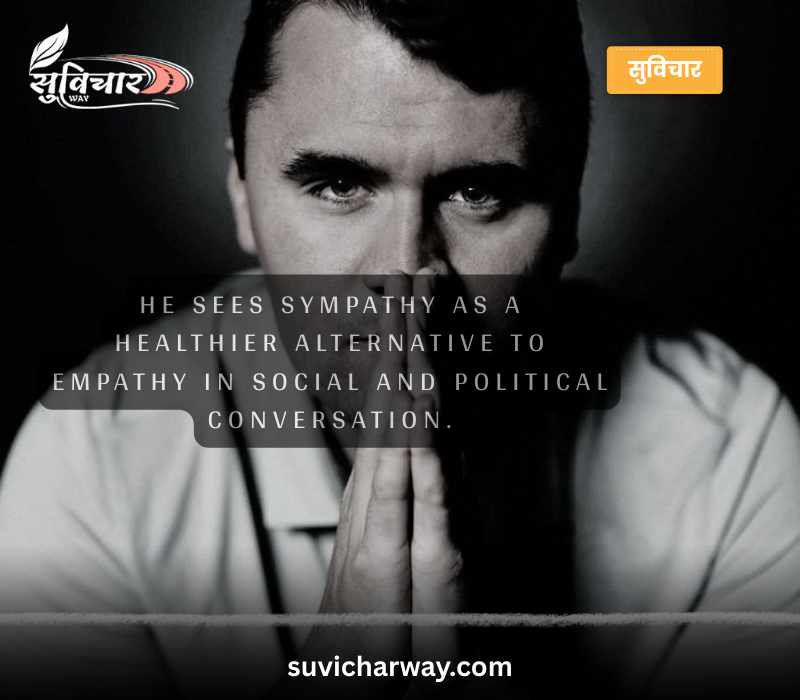
He sees sympathy as a healthier alternative to empathy in social and political conversation.
Kirk has pointed to empathy’s popularity as evidence of its misuse and dilution.
He warns that empathy can be destructive when it replaces rational judgement.
In his commentary, empathy is depicted as a conceptual trap rather than a virtue.
Kirk’s critique of empathy centers on its emotional overreach and political effectiveness.
He questions the authenticity of empathy when invoked in public dialogue.
According to Kirk, sympathy acknowledges suffering without claiming identical feeling.

He believes that sympathy aligns better with constructive engagement than empathy does.
Kirk frames empathy as a term that avoids real responsibility by focusing on feeling.
He argues that empathy’s appeal lies in sentiment rather than actionable help.
Kirk’s viewpoint is that empathy can cloud judgement and impede solutions.
He rejects empathy’s modern usage in favor of more grounded emotional terms.
According to his commentary, empathy has become a hollow concept in politics.
Kirk’s position is that emotional identification, empathy, isn’t necessary to act kindly.
He says we should sympathize, feel for people, rather than pretend to feel exactly what they feel.
In his assessment, sympathy opens the door to genuine action, empathy closes it.
He frames empathy as a philosophical distraction rather than a practical tool.
Kirk suggests that empathy’s growing cultural status harms serious discussion.
He sees a distinction between empathy and constructive social support.
Kirk claims that empathy’s emotional depth is misunderstood and overrated.
He favors emotional clarity, sympathy, over emotional immersion, empathy.
According to Kirk, empathy’s misuse makes it an ineffective basis for help.
He views empathy as an imprecise and politically weaponized concept.
Kirk’s critique suggests empathy confuses compassion with indistinguishable emotional experience.
He has pushed back against empathy as an idealized emotional standard.
Kirk sees sympathy’s expression of concern as more meaningful than empathy’s claimed emotional sharing.
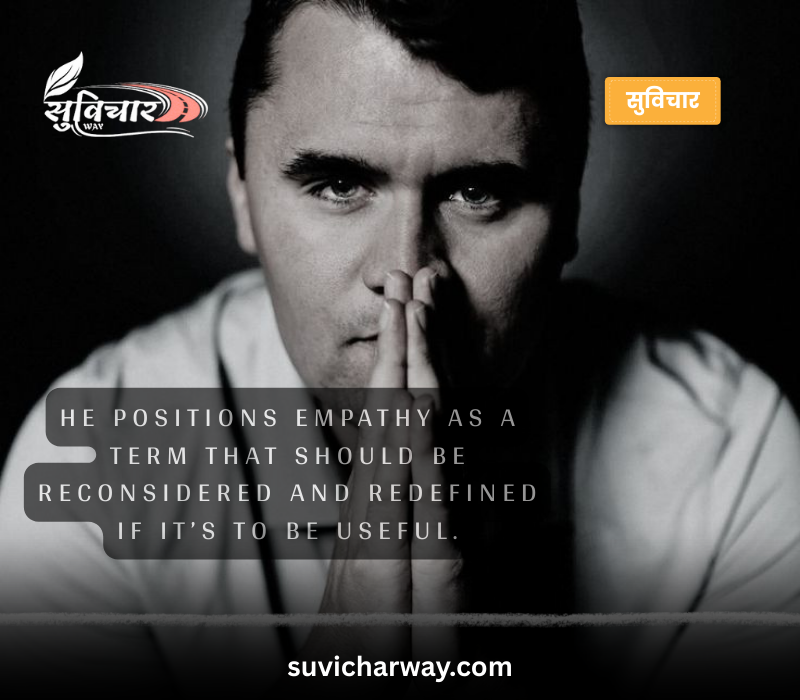
He positions empathy as a term that should be reconsidered and redefined if it’s to be useful.
Read This As well
So, why hold back? Choose your favorite from these Charlie Kirk quotes on empathy, share them widely, and see the ripple effect of likes, shares, and heartfelt discussions. Express yourself boldly, gather those positive vibes, and feel free to give this post a quick rating or share it with your circle – credit or not, your support keeps us motivated to deliver more gems like this!
Frequently Asked Questions
1. What did Charlie Kirk actually say about empathy?
Charlie Kirk expressed strong views on the term in a 2022 episode of The Charlie Kirk Show. His well-known quote is: “I can’t stand the word empathy, actually. I think empathy is a made-up, New Age term that — it does a lot of damage, but it is very effective when it comes to politics. Sympathy I prefer more than empathy.” He distinguished empathy (feeling someone’s pain as your own) from sympathy (acknowledging pain without internalizing it), arguing that unlimited empathy can enable harmful behaviors or be politically manipulative.
2. Why did Charlie Kirk criticize empathy?
Kirk believed empathy could be damaging if it led to excusing destructive actions or prioritizing distant issues over closer ones (like focusing on global concerns instead of domestic problems). He saw it as a modern, potentially phony concept—citing examples like political figures using it opportunistically—while favoring sympathy as a more balanced, arms-length compassion.
3. Does Charlie Kirk have any positive quotes on empathy?
From available sources and transcripts, Kirk was largely critical of the concept of empathy as commonly used today. There are no widely documented quotes where he praises or promotes empathy; instead, his discussions emphasize caution around it and a preference for sympathy grounded in personal responsibility and limits.
4. What’s the difference between empathy and sympathy according to Charlie Kirk?
- Empathy: Trying to fully feel and internalize someone else’s emotions or pain, which Kirk viewed as risky and potentially enabling bad behavior.
- Sympathy: Recognizing and caring about someone’s suffering without claiming to share it deeply—something he endorsed as healthier and more practical.
5. How can Charlie Kirk’s views on empathy inspire personal growth?
Even if controversial, his perspective encourages reflection:
- Set healthy boundaries in compassion to avoid burnout.
- Prioritize sympathy in debates to understand others without losing your principles.
- Use these ideas to foster thoughtful discussions in a polarized world, promoting understanding with limits.
6. Where can I find more authentic Charlie Kirk quotes?
Check official sources like past episodes of The Charlie Kirk Show, Turning Point USA archives, or verified transcripts. Here on Suvichar Way, we handpick and verify quotes daily for inspiration—bookmark us for more on empathy, compassion, and influential thinkers!
Are you a fan of all kinds of poetry? Then Shayari Read is the perfect place for you, where instead of getting straight to the point, only the words themselves speak volumes. ||We request you to please check it out at least once.||