
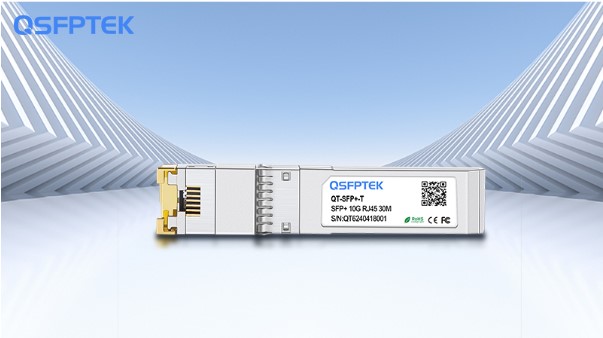
Despite the widespread adoption of fiber optics in enterprise and hyperscale networks, copper-based 10G connectivity continues to play a vital role, particularly in top-of-rack (ToR) switching architectures. Data centers face a constant demand to increase bandwidth while controlling costs and operational complexity. While fiber solutions offer high-speed and long-distance transmission, 10GBASE-T copper modules, such as the 10GBASE-T SFP+ Copper RJ-45 30m transceiver module for Cat6a and Cat7 cables, provide a practical, cost-effective alternative for short-range connections. By leveraging existing cabling infrastructure and simplifying deployment, copper modules remain highly relevant in data center environments, especially for intra-rack and adjacent-rack connectivity where distances rarely exceed 30 meters. Their continued use is a reflection of both engineering practicality and economic efficiency.
The Practical Advantages of 10GBASE-T in ToR Environments
Top-of-rack switching typically involves connecting multiple servers within a single rack or adjacent racks to a high-capacity switch. In these scenarios, the physical distances are relatively short, making copper-based solutions ideal. The 10GBASE-T SFP+ module supports gigabit-level performance over standard Cat6a or Cat7 cabling, enabling operators to achieve 10G connectivity without the need to replace existing copper infrastructure with fiber. This significantly reduces both capital expenditure and deployment time, allowing data centers to upgrade from 1G or 5G links to 10G without major structural changes. In addition, copper links simplify management and troubleshooting. Unlike fiber, which requires careful handling, cleaning, and precise termination, copper cabling is resilient to minor bends, physical stress, and handling during installation, making it easier for network administrators to maintain uptime and avoid operational disruptions.
Compatibility with Existing Cabling Infrastructure
One of the main reasons data centers favor 10G copper for ToR switching is its compatibility with installed Cat6a and Cat7 cabling. Many facilities were originally wired with high-quality twisted-pair copper to support 1G Ethernet, and replacing this cabling entirely would be disruptive and costly. The 10GBASE-T SFP+ module allows operators to maximize the value of their existing cable plants, providing a straightforward migration path to higher-speed connections. Cat6a and Cat7 cables not only support the necessary bandwidth but also offer improved shielding against crosstalk and electromagnetic interference (EMI), ensuring reliable transmission even in high-density server environments. By using copper SFP+ modules, data centers can avoid unnecessary fiber deployment for short distances, reduce installation complexity, and maintain operational continuity during upgrades.
Ease of Deployment and Flexibility
Another significant advantage of 10G copper for ToR deployments is the ease of installation. RJ-45 connectors are widely understood and standardized, and almost all network personnel are familiar with their deployment and troubleshooting. SFP+ copper modules are plug-and-play, allowing switches and servers to be upgraded with minimal effort. Unlike fiber optics, which may require additional transceivers, patch panels, or media converters, 10GBASE-T modules can be inserted directly into SFP+ slots and connected using existing copper cables. This simplicity translates into faster deployment cycles and reduced operational overhead, enabling data centers to scale their network capacity efficiently while minimizing the risk of errors during installation.
Power and Latency Considerations
Historically, one of the perceived disadvantages of 10G copper has been its slightly higher latency and power consumption compared to fiber optics. However, advances in SFP+ module design have mitigated these concerns. Modern 10GBASE-T modules offer low power consumption and predictable latency, making them suitable for ToR environments where the primary goal is high-speed, short-distance connectivity rather than ultra-long-distance transmission. Additionally, the slight increase in latency is negligible in most rack-level applications and does not impact the performance of intra-rack traffic significantly. The balance of performance, simplicity, and cost efficiency makes 10G copper a highly practical choice for short-range connections within racks.
Reliability in High-Density Server Environments
Data centers often deploy dense server configurations with numerous switches, storage devices, and other network equipment. In such environments, signal integrity and reliability are paramount. Copper cabling, when paired with high-quality 10GBASE-T SFP+ modules, provides robust performance even in electrically noisy environments. Cat6a and Cat7 cables, combined with industrial-grade RJ-45 connectors, help minimize crosstalk and EMI, ensuring stable 10G connections across all ports. Furthermore, the mechanical durability of copper cabling reduces the likelihood of accidental disconnections, physical stress, or damage during maintenance, contributing to overall network resilience. For many data centers, the predictable performance of copper outweighs the theoretical advantages of fiber for short-range rack-level interconnects.
Cost Efficiency and Total Cost of Ownership
Upgrading to fiber-based 10G solutions often involves significant investment in new transceivers, patch panels, and cable management systems. In contrast, 10GBASE-T copper modules leverage existing infrastructure, reducing both material and labor costs. The relatively low price of RJ-45 copper SFP+ modules, coupled with minimal installation requirements, lowers the total cost of ownership and provides a cost-effective path to higher-speed connectivity. This is particularly important for enterprises and mid-sized data centers that aim to increase bandwidth while adhering to strict budget constraints. Copper’s combination of affordability, compatibility, and reliability makes it a preferred choice for ToR deployments.
Conclusion
Despite the expansion of fiber networks across modern data centers, 10GBASE-T copper continues to be a practical, efficient, and cost-effective solution for top-of-rack connectivity. The 10GBASE-T SFP+ Copper RJ-45 30m module for Cat6a and Cat7 cables offers operators a reliable way to achieve high-speed intra-rack links without major cabling changes or increased complexity. Its durability, ease of deployment, and compatibility with existing infrastructure make it ideally suited for short-range data center environments, where operational continuity, installation speed, and cost efficiency are critical. For many facilities, copper is not merely a legacy medium but a strategic choice that ensures reliable 10G connectivity and enables smooth network upgrades in dense, high-performance environments. By combining practicality with performance, 10G copper modules remain a cornerstone of ToR switching architectures, bridging the gap between legacy systems and modern data center demands.